
Stay informed
Subscribe for the BDI Newsletter & Updates
Contacts
contact@burundidi.org
chairman@burundidi.org
+257 79 92 60 67 / +1 (310) 415-7827
Leave a message
EMAIL FORM
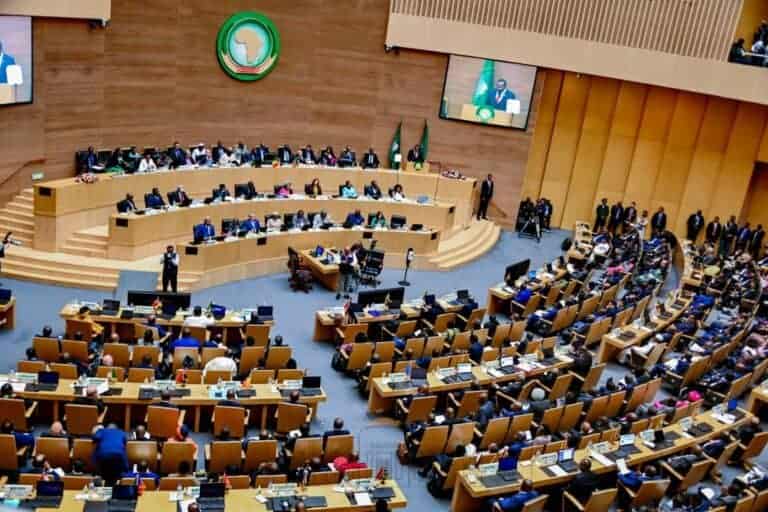
For the Burundian government , the AU presidency is clearly a matter of diplomatic repositioning. After years marked by sanctions, criticism of human rights records, controversial elections, and persistent mistrust from several international partners, holding this position sends a clear message: Burundi is back.
This presidency acts as a kind of certificate of political normalcy. It allows Burundi to put international criticism into perspective and demonstrates that, despite controversies, the country remains a legitimate actor within African institutions. In an international system where recognition between states sometimes carries more weight than internal democratic evaluation, this position offers Burundi a significant political boost and a considerable image improvement.
It is important, however, to dispel a widely held illusion. The AU presidency is primarily honorary . It offers political visibility, but little concrete decision-making power. The Burundian delegate chairs the meetings and sets the agenda to some extent, but his real power is limited by several factors.
The AU's broad policy directions are defined by complex balances between influential states, by the African Union Commission (AUC), and by financial considerations largely dependent on donors . The current Chairperson can initiate themes, set a tone, and embody a message, but cannot single-handedly transform the continental agenda. In other words, Burundi's presidency is more about diplomatic posturing than a genuine lever for African political transformation.
Another discrepancy deserves attention. On the continental stage, Burundi promotes a discourse centered on sovereignty, peace, African unity, and the rejection of foreign interference. This discourse resonates strongly in an Africa marked by geopolitical tensions and postcolonial frustrations. But this discourse contrasts sharply with the internal political reality : a narrow civic space, a weakened opposition, a media under pressure, and limited political participation, as highlighted in the recent Human Rights Watch report. This contradiction raises a troubling but legitimate question: can one embody African unity while simultaneously restricting political pluralism within its borders?
The real test of this presidency lies in the eastern Democratic Republic of Congo (DRC). Burundi, which has deployed troops alongside Kinshasa under bilateral agreements, now finds itself chairing continental discussions on this very crisis. A delicate position, to say the least.
The question here is whether Burundi can be an impartial mediator given its involvement in the conflict. So far, its positions have aligned with Kinshasa's , primarily accusing Rwanda. It's reasonable to assume that, even as president, his stance will be more one of diplomatic alignment than neutral mediation.
For the majority of Burundians, the AU presidency remains a distant, abstract event with no direct impact on daily life. It does not lower prices, resolve shortages, create jobs, or expand civil liberties in the short term.
For example, the theme chosen by the AU for 2026 is: “ Water and Sanitation for All by 2063 ,” which gives Burundi the mission of making this theme a continental political vision. However, every Burundian living in the country is well aware of the difficulties Regideso faces in ensuring a continuous water supply.
This presidency therefore serves primarily as a symbolic internal resource, mobilized in official discourse to foster a sense of national pride and reinforce the legitimacy of the government. It's a display of great diplomacy, but the concrete results are still invisible.
However, presiding over an institution is not synonymous with leadership. The latter is earned through example, credibility, and results. It is on this basis that Burundi's mandate on the Peace and Security Council will ultimately be judged by other African states, and above all, by Burundian citizens themselves, who are observing this new stage in their country's diplomacy.
