Stay informed
Subscribe for the BDI Newsletter & Updates
Contacts
contact@burundidi.org
chairman@burundidi.org
+257 79 92 60 67 / +1 (310) 415-7827
Leave a message
EMAIL FORM
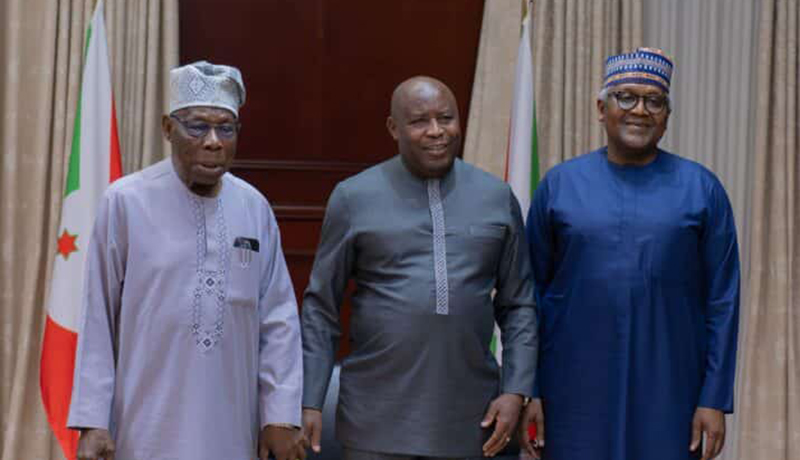
Olusegun Obasanjo is never a mere figurehead. A former head of state and mediator mandated by the UN , the African Union, and the East African Community , he understands the delicate balance of power in the Great Lakes region. His presence suggests that this visit goes far beyond purely economic considerations.
Obasanjo is also closely linked to the architecture of continental development. NEPAD, which became AUDA-NEPAD in 2018 , the African Union's development agency tasked with accelerating Agenda 2063, is one of his key priorities. With Évariste Ndayishimiye's assumption of the rotating presidency of the African Union approaching, Obasanjo's visit to Bujumbura can be interpreted as a political and institutional assessment: is Burundi ready to assume this role without damaging the continent's collective image?
Aliko Dangote's presence has never been merely decorative. Zimbabwe (2015, then 2025), Ethiopia (2025), Senegal (2025): wherever Dangote goes, resources, markets, or logistics corridors are at stake. In Burundi, the doubt is now gone: the signed MoU covers major strategic sectors: refinery, fertilizers, mines and natural resources, road and rail infrastructure, and housing. In other words, the very foundations of the real economy.
This announcement repositions Burundi not simply as a country "with potential," but as a territory with which an industrial giant is willing to plan for the long term. It remains to be seen whether local conditions will follow.
For several years now, official Burundian discourse has emphasized economic normalization and improving the business climate. Minister Marie Chantal Nijimbere, during her time at the Ministry of Trade and Transport, spoke of reviving former industries like Verundi and Cotebu. But the gap between announcements and reality remains glaring.
The business climate remains stifled by a chronic shortage of foreign currency, a high tax burden intended to plug a structural budget deficit, and regulatory uncertainties: laws that are sometimes well-conceived but unevenly enforced. The question, therefore, is not whether Burundi is attractive, but whether it can secure business opportunities.
The example of Zimbabwe is instructive. In 2015, Dangote initiated discussions under Mugabe's regime, but these came to nothing. Ten years later, in a political context deemed more transparent, he signed an investment plan with President Emmerson Mnangagwa worth nearly a billion dollars (cement plant, power station, oil pipeline). Capital waits, observes, and only commits when the necessary guarantees are in place.
The other interpretation is the one that prevails. Abuja is looking eastward. Long focused on West Africa, Nigeria is now facing a region plagued by political and security instability. East Africa and the Great Lakes, rich in strategic resources, are becoming a credible alternative.
In this scenario, Burundi, although landlocked, occupies an interesting geographical position. Could it become a secondary gateway to the region? The infrastructure and connectivity challenges remain immense, but the signed MoU suggests that the Dangote Group intends to co-develop this infrastructure, rather than simply wait for it to be built.
The visit, however, presents a stark contrast. On one side, billionaires, an impressive delegation, and promises of substantial investments. On the other, a population grappling with a high cost of living , youth unemployment, and a daily precarity that has become the norm.
The central question remains: who will benefit from this opening? Ordinary citizens, through employment, energy, fertilizers and housing? Or a political and economic elite capturing the benefits without redistribution? Especially when our public companies struggle to establish themselves , while some private companies expand beyond borders.
This is not Obasanjo's first visit to Bujumbura. In 2024 , he led a delegation of Nigerian businesspeople to the Burundi National Development Forum, without any visible concrete results. The difference today lies in three letters: MoU.
This document is not a guarantee, but at the very least, it is a starting point. It commits the Burundian state to creating a credible environment, and Dangote Group to testing, step by step, the reality of Burundi.
Burundi may finally be becoming "investment-worthy ." But more importantly, it is now under close scrutiny. And this time, it's not just about seduction, but about keeping promises. The time to put words into action has certainly come for Gitega, and perhaps this time things are working out.
